Skip to content

← Insights

Which video ads sell in 2026? What 578,750 Meta ads show

By the AfrikCru studio25 October 20265 min read

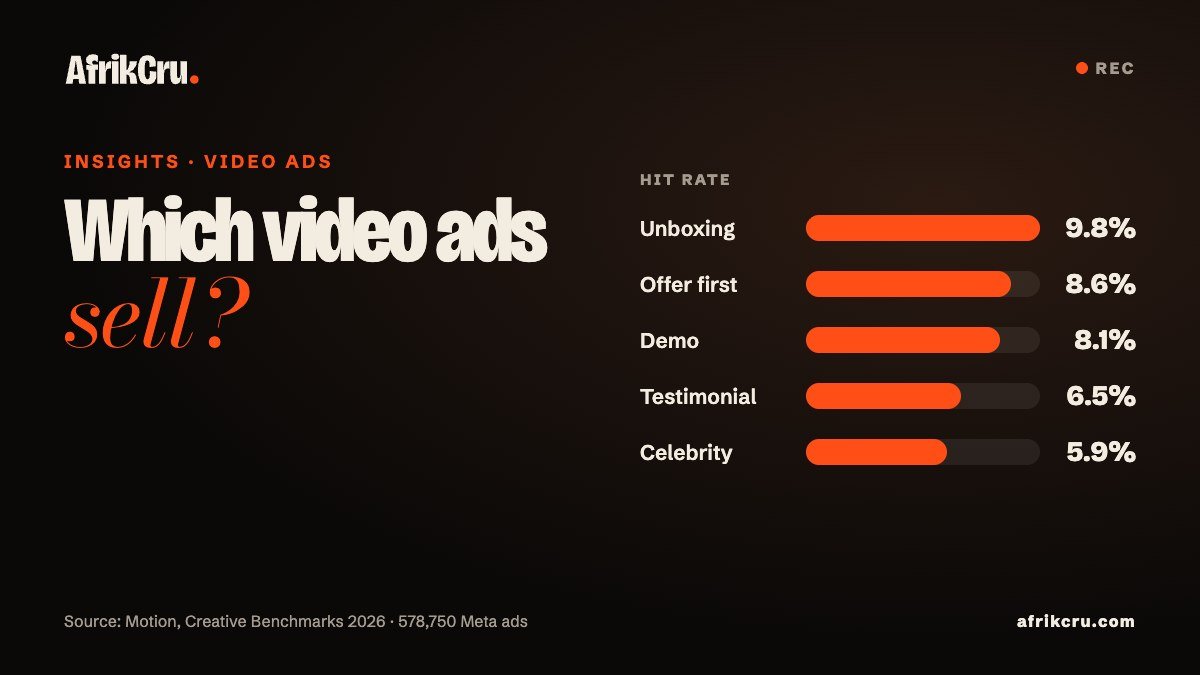
Bar chart of the hit rate of five video ad formats in Motion's 2026 study: unboxing 9.8%, offer-first 8.6%, demo 8.1%, testimonial 6.5%, celebrity 5.9%

In shortMotion studied 578,750 ads launched on Facebook and Instagram between September 2025 and January 2026. The formats that most often became winners were unboxing (9.8%), offer first (8.6%), product demo (8.1%) and testimonial (6.5%). Even so, only a small share of all ads become winners, so the brands that win are the ones that test several versions of each ad.

Before spending money on a video, most founders ask the same question: what kind of ad actually sells? Opinions are cheap. Data is better. This year, one of the largest public studies in advertising gives a clear answer on video ads that sell, with numbers. Here is what it found, where its limits are, and how we use it at AfrikCru when we make ads for African brands.

Where does the data come from?

The study is Creative Benchmarks 2026 by Motion, a creative analytics company. It covers 578,750 ads launched by 6,015 advertiser accounts on Meta (Facebook and Instagram) between 1 September 2025 and 1 January 2026, with $1.29 billion of real ad spend.

Motion calls an ad a winner when it received at least ten times the median spend of its account, and at least $500. The idea is simple: advertisers keep paying for the ads that bring results, so the ads that get the budget are the ones that work. The hit rate of a format is the share of its ads that became winners.

Which video formats win most often?

Among the formats used by enough advertisers to be compared, five stand out with a published hit rate:

Format What it shows Hit rate
Unboxing The product taken out of its box, first use 9.8%
Offer first The offer on screen from the first second: new product, price, deadline 8.6%
Demo The product in use, the real screens of an app 8.1%
Testimonial A real customer talking about the product 6.5%
Celebrity A known person with the product 5.9%

Motion places most of the other formats it ranks, such as before and after, problem and solution, how-to, behind the scenes or founder on camera, in a band of roughly 5 to 9%. Offer first also gets more of the budget than its number of ads: about 29% of the spend for about 22% of the ads.

The lesson is not that one format wins everywhere. It is that the formats which show the product and the offer clearly, fast, win more often than the ones that only create a mood.

Why do most ads never become winners?

Because winning is rare by design. Motion puts the share of winners at around 5 to 8% of all ads, and says plainly that low hit rates are a statistical feature, not a sign of bad work. In practice, this means a brand that publishes one ad and waits is betting on a small chance. A brand that publishes several versions, compares them after a few days and keeps paying for the best one, gives itself many more chances.

This is why every ad we make at AfrikCru comes with two different openings, called hooks. Same product, same message, two ways of stopping the scroll. You run both and keep the one your customers prefer.

What does TikTok recommend for the first seconds?

TikTok’s own creative best practices point in the same direction:

  • Introduce your offer in the first 3 seconds, and put your hook in the first 6 seconds.
  • Film vertical, in 9:16, at 720p or more, with sound or music.
  • Add captions or text on screen, at about 5 to 10 words per second.
  • Show people: creators, employees or customers.

Does this apply to African brands?

Partly, and it is worth being honest about it. Motion’s data is global and comes from Meta advertisers, many of them online shops. It does not isolate Africa, and Motion itself notes that results vary by sector. So treat these numbers as a strong starting point, not a law.

What we know about the audience helps. In Rwanda, DataReportal’s Digital 2026 report counts an ad reach of 1.35 million on Facebook and 576,000 on Instagram in late 2025, with Instagram up 24% in a year, and 570,000 LinkedIn members, up 27%. These are ad reach and member counts, not daily users, but the direction is clear: more people to reach with video every year, mostly on a phone.

Two habits matter even more in our markets. Mobile data is not free, so a short, light file travels further. And many customers decide on WhatsApp, so a video that also fits a WhatsApp status works twice.

How can you use this for your next ad?

  1. Start with the product in use. The real app screens, the real dish, the real room. A demo is the safest base.
  2. Put the offer on screen from the first second. A new product, a price, a date. If you sell physical products, try an unboxing.
  3. Use real customers only. A testimonial works because it is true. Ask for written permission, and never invent one.
  4. Make two hooks, not one. Run both for a few days on a small budget, then put your money on the better one.
  5. Deliver every format. 9:16 for Reels, TikTok and status, 4:5 for the feed, 16:9 for YouTube.
  6. Speak your customers’ language. English, French, Kinyarwanda or Swahili: the closer the voice, the stronger the ad.

This is exactly how our ads are built. A Spark ad is a 15 second ad delivered as 6 files: 2 hooks in 3 formats. A Promo Pack gives you 3 offer-first ads for a sale period. And if you want to appear yourself, Founder Cut turns three phone takes into an edited video. Every price is on the pricing page, and you can send us your product to get a quote.

Frequently asked questions

Which video ad format sells best?

In Motion’s 2026 study of 578,750 Meta ads, unboxing had the highest published hit rate (9.8%), followed by offer first (8.6%), product demo (8.1%) and testimonial (6.5%). Results vary by sector, so test more than one format.

How many versions of an ad should I test?

At least two. Only a small share of ads become winners (about 5 to 8% in Motion’s data), so testing two or more hooks for the same ad gives you a better chance of finding one that works.

What should the first 3 seconds of an ad show?

TikTok advises introducing your offer in the first 3 seconds and placing the hook in the first 6. Show the product or a person straight away, with the offer as text on screen.

Which format should I export?

Vertical 9:16 for Reels, TikTok and WhatsApp status, 4:5 for the Facebook and Instagram feed, and 16:9 for YouTube. Every AfrikCru ad is delivered in these three formats.

Is this data valid for Africa?

It is global data from Meta advertisers and does not isolate Africa. Use it as a starting point, then let your own tests decide.

Sources (read on 25 October 2026)

Next film

Your business
deserves a film.

In shortMotion studied 578,750 ads launched on Facebook and Instagram between September 2025 and January 2026. The formats that most often became winners were unboxing (9.8%), offer first (8.6%), product demo (8.1%) and testimonial (6.5%). Even so, only a small share of all ads become winners, so the brands that win are the ones that test several versions of each ad.

Before spending money on a video, most founders ask the same question: what kind of ad actually sells? Opinions are cheap. Data is better. This year, one of the largest public studies in advertising gives a clear answer on video ads that sell, with numbers. Here is what it found, where its limits are, and how we use it at AfrikCru when we make ads for African brands.

Where does the data come from?

The study is Creative Benchmarks 2026 by Motion, a creative analytics company. It covers 578,750 ads launched by 6,015 advertiser accounts on Meta (Facebook and Instagram) between 1 September 2025 and 1 January 2026, with $1.29 billion of real ad spend.

Motion calls an ad a winner when it received at least ten times the median spend of its account, and at least $500. The idea is simple: advertisers keep paying for the ads that bring results, so the ads that get the budget are the ones that work. The hit rate of a format is the share of its ads that became winners.

Which video formats win most often?

Among the formats used by enough advertisers to be compared, five stand out with a published hit rate:

Format What it shows Hit rate
Unboxing The product taken out of its box, first use 9.8%
Offer first The offer on screen from the first second: new product, price, deadline 8.6%
Demo The product in use, the real screens of an app 8.1%
Testimonial A real customer talking about the product 6.5%
Celebrity A known person with the product 5.9%

Motion places most of the other formats it ranks, such as before and after, problem and solution, how-to, behind the scenes or founder on camera, in a band of roughly 5 to 9%. Offer first also gets more of the budget than its number of ads: about 29% of the spend for about 22% of the ads.

The lesson is not that one format wins everywhere. It is that the formats which show the product and the offer clearly, fast, win more often than the ones that only create a mood.

Why do most ads never become winners?

Because winning is rare by design. Motion puts the share of winners at around 5 to 8% of all ads, and says plainly that low hit rates are a statistical feature, not a sign of bad work. In practice, this means a brand that publishes one ad and waits is betting on a small chance. A brand that publishes several versions, compares them after a few days and keeps paying for the best one, gives itself many more chances.

This is why every ad we make at AfrikCru comes with two different openings, called hooks. Same product, same message, two ways of stopping the scroll. You run both and keep the one your customers prefer.

What does TikTok recommend for the first seconds?

TikTok’s own creative best practices point in the same direction:

  • Introduce your offer in the first 3 seconds, and put your hook in the first 6 seconds.
  • Film vertical, in 9:16, at 720p or more, with sound or music.
  • Add captions or text on screen, at about 5 to 10 words per second.
  • Show people: creators, employees or customers.

Does this apply to African brands?

Partly, and it is worth being honest about it. Motion’s data is global and comes from Meta advertisers, many of them online shops. It does not isolate Africa, and Motion itself notes that results vary by sector. So treat these numbers as a strong starting point, not a law.

What we know about the audience helps. In Rwanda, DataReportal’s Digital 2026 report counts an ad reach of 1.35 million on Facebook and 576,000 on Instagram in late 2025, with Instagram up 24% in a year, and 570,000 LinkedIn members, up 27%. These are ad reach and member counts, not daily users, but the direction is clear: more people to reach with video every year, mostly on a phone.

Two habits matter even more in our markets. Mobile data is not free, so a short, light file travels further. And many customers decide on WhatsApp, so a video that also fits a WhatsApp status works twice.

How can you use this for your next ad?

  1. Start with the product in use. The real app screens, the real dish, the real room. A demo is the safest base.
  2. Put the offer on screen from the first second. A new product, a price, a date. If you sell physical products, try an unboxing.
  3. Use real customers only. A testimonial works because it is true. Ask for written permission, and never invent one.
  4. Make two hooks, not one. Run both for a few days on a small budget, then put your money on the better one.
  5. Deliver every format. 9:16 for Reels, TikTok and status, 4:5 for the feed, 16:9 for YouTube.
  6. Speak your customers’ language. English, French, Kinyarwanda or Swahili: the closer the voice, the stronger the ad.

This is exactly how our ads are built. A Spark ad is a 15 second ad delivered as 6 files: 2 hooks in 3 formats. A Promo Pack gives you 3 offer-first ads for a sale period. And if you want to appear yourself, Founder Cut turns three phone takes into an edited video. Every price is on the pricing page, and you can send us your product to get a quote.

Frequently asked questions

Which video ad format sells best?

In Motion’s 2026 study of 578,750 Meta ads, unboxing had the highest published hit rate (9.8%), followed by offer first (8.6%), product demo (8.1%) and testimonial (6.5%). Results vary by sector, so test more than one format.

How many versions of an ad should I test?

At least two. Only a small share of ads become winners (about 5 to 8% in Motion’s data), so testing two or more hooks for the same ad gives you a better chance of finding one that works.

What should the first 3 seconds of an ad show?

TikTok advises introducing your offer in the first 3 seconds and placing the hook in the first 6. Show the product or a person straight away, with the offer as text on screen.

Which format should I export?

Vertical 9:16 for Reels, TikTok and WhatsApp status, 4:5 for the Facebook and Instagram feed, and 16:9 for YouTube. Every AfrikCru ad is delivered in these three formats.

Is this data valid for Africa?

It is global data from Meta advertisers and does not isolate Africa. Use it as a starting point, then let your own tests decide.

Sources (read on 25 October 2026)

Prochain film

Votre business
mérite un film.